# This is NOT a good way to build an agent.
# It's a tool-augmented chatbot pretending to be one.

import openai
import json

def bad_travel_agent(prompt: str):
    """A 'travel agent' that's really just a single LLM call with a tool."""
    print(f"USER: {prompt}")

    response = openai.chat.completions.create(
        model="gpt-4o",
        messages=[{"role": "user", "content": prompt}],
        tools=[{
            "type": "function",
            "function": {
                "name": "search_flights",
                "description": "Search for flights between two cities",
                "parameters": {
                    "type": "object",
                    "properties": {
                        "origin": {"type": "string"},
                        "destination": {"type": "string"},
                        "date": {"type": "string"},
                    },
                    "required": ["origin", "destination", "date"],
                },
            },
        }],
    )

    msg = response.choices[0].message

    if msg.tool_calls:
        tc = msg.tool_calls[0]
        args = json.loads(tc.function.arguments)
        # No validation, no error handling, no retries
        result = f"Found flights from {args['origin']} to {args['destination']}"
        print(f"RESULT: {result}")
    else:
        print(f"ASSISTANT: {msg.content}")


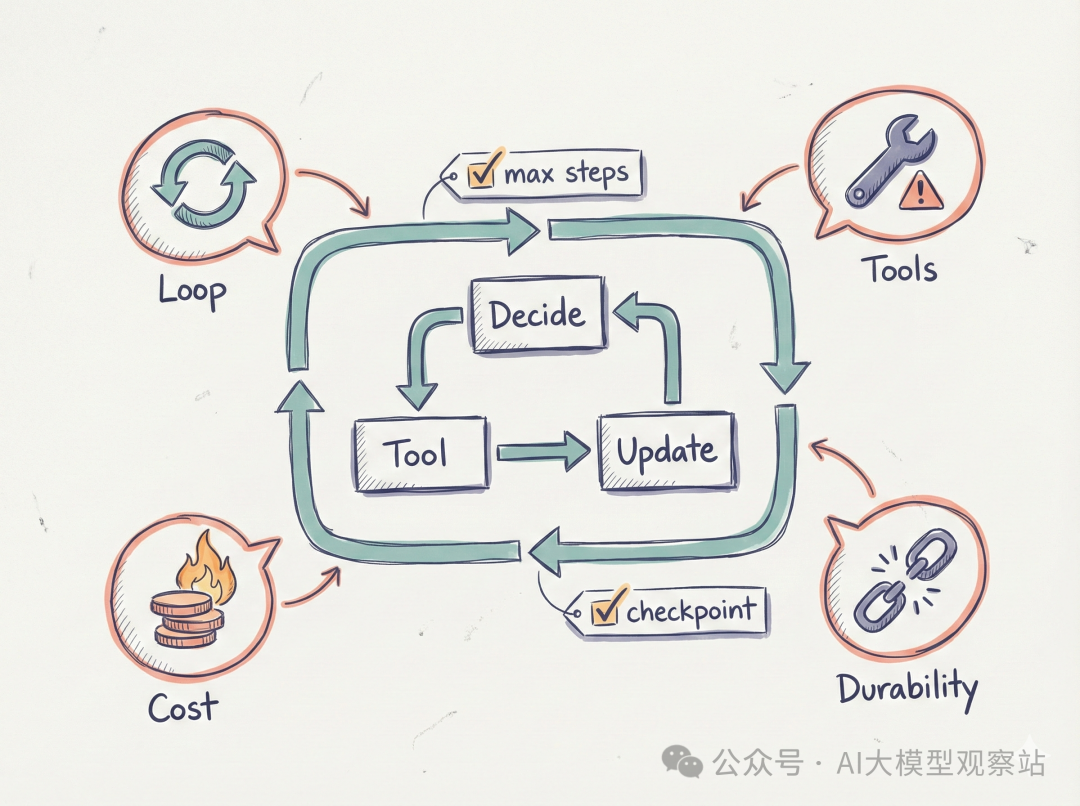
# --- Why this is broken ---
# 1. No state: It can't plan a multi-step trip. It searches flights,
#    then immediately forgets. It can never book a hotel next.
# 2. No structured output: The LLM returns free text. Good luck
#    parsing "Found flights..." into something your UI can render.
# 3. No budget: If the LLM hallucinates a tool loop, you pay forever.
# 4. No validation: What if the LLM sends "tomorrow" instead of
#    "2026-03-15" for the date? The API call will fail silently.
# 5. No recovery: Crash = all progress lost. No checkpoint, no resume.
# 6. No loop: It can only do ONE thing. A real trip needs flights,
#    hotels, activities, restaurants - all composed together.
# A proper travel itinerary agent with structured state,
# typed outputs, validated tools, and built-in budgets.
#
# pip install pydantic-ai logfire

import asyncio
import httpx
from dataclasses import dataclass
from datetime import date
from dotenv import load_dotenv
import os
load_dotenv()

from pydantic import BaseModel, Field
from pydantic_ai import Agent, RunContext, ModelRetry
from pydantic_ai.models.google import GoogleModel
from pydantic_ai.providers.google import GoogleProvider

provider = GoogleProvider(api_key=os.getenv("GEMINI_API_KEY"))
model = GoogleModel("gemini-2.5-pro", provider=provider)


import logfire

# 1. OBSERVABILITY: Set up tracing from the start
# Every decision, tool call, and token cost is tracked automatically.
logfire.configure()
logfire.instrument_pydantic_ai()


# 2. STRUCTURED STATE: Define what the agent knows
# This is the agent's "memory" - passed via dependency injection,
# not mixed into the prompt.

@dataclass
class TripContext:
    origin: str
    destination: str
    start_date: date
    end_date: date
    budget_usd: float
    traveler_notes: str
    http_client: httpx.AsyncClient  # shared client for all tool calls


# 3. STRUCTURED OUTPUT: Define exactly what the agent returns
# No more parsing free text. The LLM must return this schema.
# Pydantic AI validates it automatically; if the LLM gets it wrong,
# it retries with the validation error as feedback.

class Activity(BaseModel):
    time: str = Field(descriptinotallow="e.g., '9:00 AM' or 'Afternoon'")
    name: str = Field(descriptinotallow="Name of the activity or place")
    description: str = Field(descriptinotallow="One-sentence why it's worth it")
    estimated_cost_usd: float = Field(ge=0)

class DayPlan(BaseModel):
    day_number: int = Field(ge=1)
    date: str
    theme: str = Field(descriptinotallow="e.g., 'Old City & Street Food'")
    activities: list[Activity] = Field(min_length=2, max_length=6)
    meals: list[Activity] = Field(min_length=1, max_length=3)

class TripItinerary(BaseModel):
    title: str = Field(descriptinotallow="A catchy name for the trip")
    summary: str = Field(descriptinotallow="2-3 sentence overview of the trip")
    days: list[DayPlan] = Field(min_length=1)
    total_estimated_cost_usd: float = Field(ge=0)
    packing_tips: list[str] = Field(min_length=1, max_length=5)


# 4. THE AGENT: Configured with guardrails baked in

travel_agent = Agent(
    # "anthropic:claude-sonnet-4-6",
    # "google-gla:gemini-2.5-flash", (can pass like that or we can
    #  define it separately like we are doing here)
    model,
    deps_type=TripContext,
    output_type=TripItinerary,            # <-- Forces structured output
    instructinotallow=(
        "You are an expert travel planner. Use the available tools to research "
        "the destination, then return a detailed day-by-day itinerary. "
        "Stay within the traveler's budget. Respect their preferences. "
        "Be specific - use real place names, not generic suggestions."
    ),
    model_settings={
        "temperature": 0.3,
        "max_tokens": 4096,
    },
    retries=2,                             # Auto-retry on validation failure
)


# 5. TOOLS: Validated, typed, with access to shared state
# Tools use dependency injection (RunContext) to access TripContext.
# Pydantic AI validates all arguments BEFORE execution.

@travel_agent.tool
async def get_weather_forecast(
    ctx: RunContext[TripContext],
    city: str,
    check_date: str,
) -> str:
    """Get the weather forecast for a city on a specific date."""
    # The key point: ctx.deps gives typed access to shared state.
    try:
        r = await ctx.deps.http_client.get(
            "https://api.weatherapi.com/v1/forecast.json",
            params={"q": city, "dt": check_date, "key": os.getenv("WEATHERAPI_API_KEY")},
        )
        if r.status_code != 200:
            # Raise ModelRetry so the agent knows the tool failed
            # and can decide to try again or skip.
            raise ModelRetry(f"Weather API returned {r.status_code}. Skipping weather forecast.")
        data = r.json()
        condition = data["forecast"]["forecastday"][0]["day"]["condition"]["text"]
        high_c = data["forecast"]["forecastday"][0]["day"]["maxtemp_c"]
        return f"{city} on {check_date}: {condition}, high of {high_c}°C"
    except httpx.RequestError:
        raise ModelRetry("Weather API unreachable. Skipping weather forecast.")


@travel_agent.tool
async def search_attractions(
    ctx: RunContext[TripContext],
    query: str,
    category: str,  # "sightseeing" | "food" | "nightlife" | "nature"
) -> str:
    """Search for attractions and activities at the destination."""
    # In production, this calls Google Places, Yelp, or a similar API.
    # For this repo snippet, we default to a deterministic mock so the demo runs offline.
    base_url = os.getenv("ATTRACTIONS_API_URL")
    if not base_url:
        return (
            f"(mock) Top {category} ideas near {ctx.deps.destination} for '{query}':\n"
            "- Fushimi Inari Taisha (early morning)\n"
            "- Kiyomizu-dera + Sannenzaka stroll\n"
            "- Nishiki Market (vegetarian-friendly options)\n"
            "- Arashiyama Bamboo Grove + Tenryu-ji\n"
        )

    try:
        r = await ctx.deps.http_client.get(
            f"{base_url.rstrip('/')}/attractions",
            params={
                "q": query,
                "near": ctx.deps.destination,
                "category": category,
            },
        )
    except httpx.RequestError:
        return (
            f"(mock) Attractions API unreachable; using fallback results for {ctx.deps.destination}.\n"
            "- Fushimi Inari Taisha\n"
            "- Kiyomizu-dera\n"
            "- Nishiki Market\n"
        )

    if r.status_code != 200:
        raise ModelRetry("Attractions API failed. Try a broader query.")
    return r.text


@travel_agent.tool_plain
def check_budget_remaining(
    total_budget_usd: float,
    spent_so_far_usd: float,
) -> str:
    """Check how much budget is left for planning remaining days."""
    remaining = total_budget_usd - spent_so_far_usd
    if remaining < 0:
        raise ModelRetry(
            f"Over budget by ${abs(remaining):.0f}! "
            "Re-plan with cheaper alternatives."
        )
    return f"${remaining:.0f} remaining out of ${total_budget_usd:.0f}"


# 6. DYNAMIC INSTRUCTIONS: Inject user context at runtime
# This runs before each agent call and adds personalized context
# to the system prompt, keeping the base instructions clean.

@travel_agent.instructions
def personalize(ctx: RunContext[TripContext]) -> str:
    t = ctx.deps
    nights = (t.end_date - t.start_date).days
    return (
        f"\n--- Trip Details ---\n"
        f"Route: {t.origin} → {t.destination}\n"
        f"Dates: {t.start_date} to {t.end_date} ({nights} nights)\n"
        f"Budget: ${t.budget_usd:.0f} total\n"
        f"Traveler notes: {t.traveler_notes}\n"
    )


# 7. RUN IT: With proper lifecycle management

async def plan_trip():
    async with httpx.AsyncClient(timeout=30.0) as client:
        trip_ctx = TripContext(
            origin="Delhi",
            destinatinotallow="Kyoto",
            start_date=date(2026, 4, 1),
            end_date=date(2026, 4, 5),
            budget_usd=2000.0,
            traveler_notes="I love temples and street food. Vegetarian.",
            http_client=client,
        )

        result = await travel_agent.run(
            "Plan my trip!",
            deps=trip_ctx,
        )

        # result.output is a fully validated TripItinerary object.
        # Not a string. Not JSON you have to parse. A typed Python object.
        itinerary = result.output

        print(f"\n{'='*50}")
        print(f"🗾  {itinerary.title}")
        print(f"{'='*50}")
        print(f"\n{itinerary.summary}\n")

        for day in itinerary.days:
            print(f"\n📅  Day {day.day_number} - {day.theme}")
            print(f"   {day.date}")
            for act in day.activities:
                print(f"   {act.time}: {act.name} (${act.estimated_cost_usd:.0f})")
                print(f"           {act.description}")
            print(f"   🍽 ️ Meals:")
            for meal in day.meals:
                print(f"      {meal.time}: {meal.name} (${meal.estimated_cost_usd:.0f})")

        print(f"\n💰  Estimated Total: ${itinerary.total_estimated_cost_usd:.0f}")
        print(f"🎒  Packing Tips: {', '.join(itinerary.packing_tips)}")

        # Observability: token usage and cost are tracked automatically
        # via Logfire. Check your dashboard at https://logfire.pydantic.dev
        print(f"\n📊  Token usage: {result.usage()}")


if __name__ == "__main__":
    asyncio.run(plan_trip())

 图片
图片 图片
图片